
Butte County Directory Collections by Year
The strongest local city directory resource is the Historical Butte County City Directories project created by Butte County Library and CSU Chico. The scans preserve the title page, publisher context, page image, and searchable OCR for a partial but unusually specific run. The first local directory appeared in 1881. Later volumes cover Chico, Oroville, Biggs, Durham, Gridley, Hamilton City, Paradise, Sterling City, Palermo, Wyandotte, and Stirling City in varying years and editions.
| Collection | Years | Publisher | Where Held | Access |
|---|---|---|---|---|
| City and County Directory of Yuba, Sutter, Colusa, Butte and Tehama Counties | 1881 | L. M. McKinney & Co. | CSU Chico and library partnership | Free scan and OCR |
| Chico City Directory | 1898; 1904-05 | H. U. Ensign; Scollard Directory Co. | Digital collection and partial local sets | Free scan and OCR |
| Chico and Chico-Oroville directories | 1907; 1909; 1910 | Directory Publishing Co.; Crick's Bookstore; San Francisco imprint | CSU Chico / Butte Library project | Free digital access |
| R. L. Polk and Polk volumes | Selected 1911-1950 | R. L. Polk | CSU Chico / Butte Library project | Free scans and OCR |
The run is not continuous. The local sets lack every year from 1882 through 1904 except separately held 1898 and 1904-05 volumes, and the research identifies missing 1917, 1919, 1920, and 1925. The surviving Polk list is 1911, 1912, 1913, 1914, 1915, 1916, 1918, 1921, 1922, 1923, 1924, 1926, 1927, 1929, 1931, 1933, 1934-35, 1937, 1939, 1940, 1945, 1948, and 1950. No authoritative evidence establishes a post-1950 printed, criss-cross, or telephone-book shelf, or proves that 1950 was the final printed directory.
CSU Chico's Butte Directory Project
The CSU Chico digital collection is the authoritative online home for the surviving Butte directory scans. Chico Library and Meriam Special Collections had partial sets, and Friends groups funded scanning in 2004 as the paper volumes deteriorated. That preservation history explains both the value of the image and the uneven year coverage.
OCR makes a surname, street, or business word findable, but the recognition layer can join words, lose initials, or misread a small type mark. Open the page scan after every hit. Capture the title page and publisher before copying a name, then note the page number, volume year, and whether the entry came from the alphabetical or street-order half. The image is the source; OCR is only the route to it.
When a name is missing, test a spelling variant, a married name, initials, or a neighboring year. A gap can reflect the surviving set rather than a move. The Butte County Library genealogy page is the practical companion for obituary requests, newspapers, and other local collections.
Missing Years in Butte County Directories
Directory years form a map of what survived, not a promise that a volume was printed every year. Mark the gaps before drawing a conclusion about a household. The publisher and title page also matter because a multi-county volume may place a person under a different community heading than a Chico or Oroville edition.
- 1881: the first local multi-county directory in the surviving Butte run.
- 1898: a separate Chico City Directory by H. U. Ensign.
- 1904-05: a Chico volume by Scollard Directory Co., followed by a 1907 edition.
- 1909-1916: Chico-Oroville and Polk coverage with publisher and year changes.
- 1918-1950: selected Polk years, including known gaps at 1919, 1920, and 1925.
There is no verified basis for filling a missing year with a neighboring volume's address. Use deeds, newspapers, census schedules, permits, or a later directory to test an inference. The absence of an entry can mean a missing volume, a changed spelling, an unlisted person, or a move.
Decoding a Butte County Directory Entry
An inspected 1933 Polk page shows how much information can sit in a short line. Entries at 418 Flume group several people by address and can include a personal name, spouse in parentheses, an h householder mark, an r residence or room notation, a widow note, an occupation abbreviation, business information, a rear-house notation, and a business telephone. The 1933 Polk scan should be read beside its page image, not from OCR alone.
| Name | Surname and given name or initials, as printed by that publisher |
|---|---|
| Spouse | Often placed in parentheses after the named person |
| Occupation | Historical occupation abbreviation, sometimes with business information |
| Address | House number and street, including a rear-house or business notation when printed |
| Household mark | h may mark a householder; r can mark residence or a room arrangement |
| Widow note | wid followed by a deceased spouse's name can be a genealogy clue |
- Criss-cross directory
- A street-order section that starts with a street and house number instead of a surname.
- Householder index
- An entry or index that identifies the person treated as the household head for that edition.
- Abbreviation key
- The publisher's explanation of short occupation and residence marks, worth photographing before searching.
- Observation year
- The directory's compilation or imprint year, which does not prove a person's presence every day.
Do not silently expand initials or assume a named spouse stayed in the household for the full year. Read the address, mark, and neighboring entries together.
Note: A directory mark describes the compiler's entry for one edition and should not be treated as a current identity or residence finding.
Criss-Cross Pages in Butte Directories
The reverse section changes the search direction. Instead of starting with a surname, start with a street and house number, then read the occupant or telephone entry attached to that address. This is especially useful when a surname is misspelled, a spouse is listed separately, or an occupant appears only as a roomer or resident mark. It also places nearby entries next to one another, which can reveal an address pattern without turning the page into a current block roll.
Street-order pages are not present in every surviving Butte volume, and the research does not establish a complete post-1950 criss-cross run. When a reverse page is missing, use the alphabetical section, the next available year, and the recorded property trail. Keep the printed street spelling because an old road name may not match a current map.
Note: A reverse directory points to a publication-year entry; it does not certify ownership, current occupancy, or every member of a household.
Tracing Butte County Residents Across Years
A household trail is strongest when each volume answers one small question. Start with a known name or address, copy the entry exactly, and then move one available year earlier or later. Pair the directory with a census schedule rather than treating the years as interchangeable. Deeds distinguish an occupant from a property owner, while permits and Sanborn maps can show whether the building or street number changed.
- Find the first available Butte directory year containing the name, street, or address clue.
- Record the title page, publisher, page, spelling, spouse notation, address, and abbreviation key.
- Move to the next surviving year and compare the address before assuming a new person.
- Switch to the criss-cross pages when the surname changes or the household disappears.
- Pair directory evidence with the 1940 or 1950 federal census, the 1852 state census, and local deeds or obituaries.
When a name disappears, test the missing-year list first. Then look for a move, a death, a changed name, a different community heading, or a person who was not included by that publisher. An obituary request or probate record can explain a disappearance, but no single absence supplies the answer.
Note: A missing name can reflect a missing volume or a changed entry, so absence alone is not proof that a household left.
Butte County's 1852 Resident Census
The 1852 California census is an important companion to the city directory shelf. Butte County was incorporated on February 18, 1850, during rapid Gold Rush migration, when the federal 1850 count was difficult. The State Archives holds the original, and the State Library provides microfilm plus a DAR transcription and index that includes Butte. This early state census can anchor a name before the first local directory appeared in 1881.
The later cutoff is just as important. The 1950 census is presently the latest public federal population schedule under the 72-year rule. Directory years between those two census points add address and occupation detail, while deeds, probate, newspapers, church registers, cemetery evidence, permits, and Sanborn maps test identity and place. Use the California State Library genealogy resources to locate the census path, then compare the result with the local scan.
This is one reason a Butte County city directory search should preserve provenance. A 1852 census line, a 1933 directory entry, and a deed from another year are three observations, not one continuous resident record.
Butte County Sanborns and Deeds
Sanborn maps help test whether an address and structure fit the directory evidence. The local anchors include Chico Dakin 1885; Chico Sanborn sheets from 1886, 1890, 1902, 1909, and 1921; Biggs 1909; Gridley 1924; and Oroville 1926. The 1921 Chico base includes paste-over revisions dated 1923, 1925, 1927, 1938, 1943, and 1945-49. The 1921 Chico set has 81 sheets. No digitized Paradise sheet was located in the research.
The Library of Congress Sanborn collection can supply the map image, while a deed supplies the legal description and parties. Compare the street number, building footprint, use, and neighboring lots. The map is not a deed, and the directory is not a survey, but the three sources can expose a renumbered street, a rebuilt structure, or a parcel split.
For current address-keyed work, hand the modern parcel chain to the Butte County street directory. The historical collection remains the place to read the older volume, publisher, and entry context.
Butte County Library and Directory Access
The Butte County Library genealogy, newspapers, obituaries, and records page is the local fallback when a scan, OCR hit, or newspaper archive is hard to use remotely. Staff can accept an obituary or article request with a full name, approximate event date, place, and known newspaper. Branch or staff access may also reach licensed resources unavailable from home, and microfilm can fill a gap in a digital run.
Meriam Library Special Collections and University Archives at CSU Chico hold regional collections, photographs, campus publications, and yearbooks. The Butte County Historical Society adds photographs, vertical files, family and local-history material, and research contact with names, dates, places, and a clear objective. Use each channel for the collection it holds rather than expecting one archive to reproduce every year.
The Butte County Historical Society archive page identifies the local historical research channel.
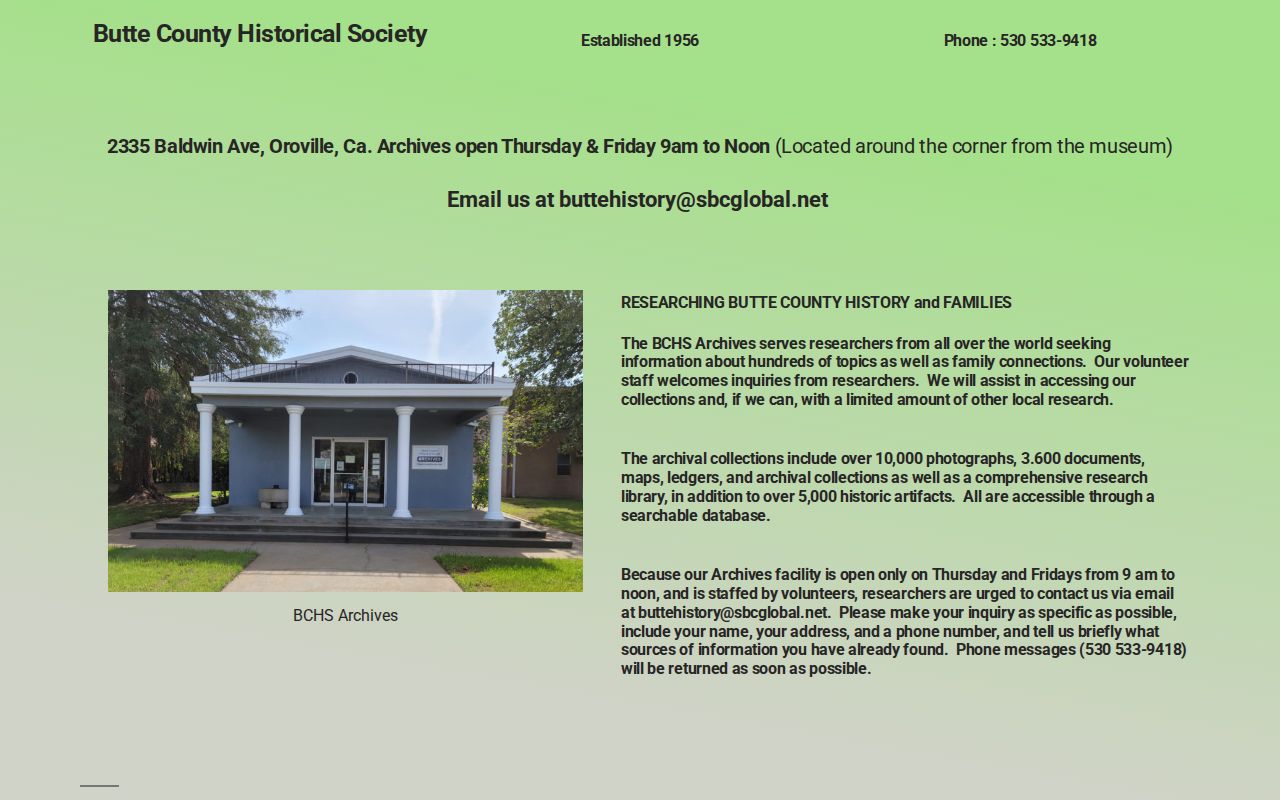
The archive image reinforces the practical rule for a Butte County city directory search: bring a name, date, place, and record objective, then verify the scan or finding with the holding institution.